Amla: plant and growing conditions
AMLA · BOTANICAL PROFILE

Amla(Amla)

Phyllanthus emblica

A tart little fruit with a rich phytochemical profile

BOTANICALS & EVIDENCE

Amla Ingredients, SOD-Like and Antioxidant Testing

Amla, or Indian gooseberry, is Phyllanthus emblica. This page brings together its origins and key phytochemicals with SOD-Like, ORAC and quantitative composition results for submitted Amla samples.

Botanical name
Phyllanthus emblica
On this page
Test items such as polyphenols, catechins and coenzyme Q10
Data checked

What do these test results tell us?

Amla extract, fermented powder and peptide extract powder are different submitted samples. Results must not be treated as one ingredient batch or finished product. The sum of 8 catechin measurements is 1.50 mg/g, including EGCG at 0.10 mg/g; these figures are not interchangeable.

The information below covers botanical background or tests on specific samples. In vitro antioxidant measurements alone do not establish anti-inflammatory effects or disease-related benefits in humans.

Catechin source report: 2023-11-16 Original report, OHC 231110-F009A ↗ . The eight measurements are summed on this page; the total is not a separate test item in the report.

Check Amla Original test reports and sample details →
AMLA · VITAMIN C · POLYPHENOLS

Fresh amla What makes it distinctive?

Explore Amla's composition, from vitamin C, hydrolyzable tannins and polyphenols in fresh fruit to SOD-Like activity, ORAC and CoQ10 measured in submitted samples.

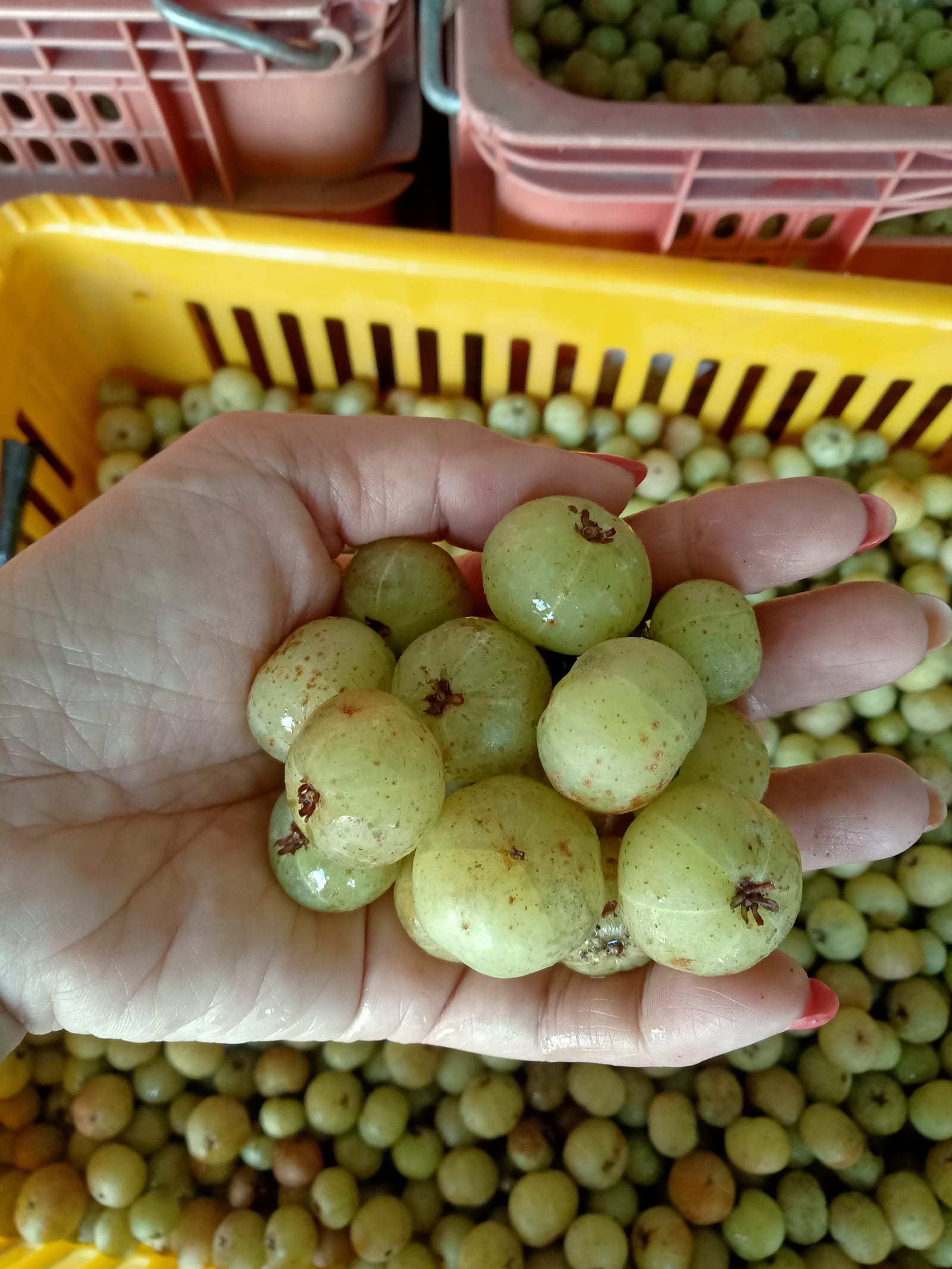
Whole fresh Amla fruit after harvest
Hojing International ingredient records
01

Fresh fruit: vitamin C, tannins and polyphenols

There is more to Amla, or Indian gooseberry, than its tart flavor.

Amla contains vitamin C, hydrolyzable tannins, phenolic acids and flavonoids. Measured values depend on variety, ripeness and analytical methods. Compounds described in ingredient literature are not necessarily detected in every product.

Representative phytochemicals discussed in the literature

  • Hydrolyzable tannins Punigluconin、Pedunculagin
    Chebulagic acid、Corilagin、Geraniin
  • Emblicanins Emblicanin A、Emblicanin B
    Identification findings differ between studies
  • Phenolic acids Gallic acid
    Ellagic acid
  • Flavonoids and catechins Rutin, Quercetin
    EGCG and other catechin polyphenols

Emblicanin A/B were reported as Amla constituents in earlier research, but later analytical studies did not find both in their extracts. Read these findings alongside the sample details and identification methods. Compound identification study ↗ Phytochemical literature overview ↗

02

1000 days of fermentation, alongside measured results

From fresh-fruit composition to tests on processed and fermented samples.

For the 1000-day fermentation process without added sugar, see the Process introduction ↗ . The results below are converted to a per-100g basis but come from different samples, including Amla extract, fermented powder and peptide extract powder. They are not a complete composition profile for one finished-product batch or a before-and-after fermentation study.

ORAC

208,000μM TE / 100g

Trolox equivalents; units reproduced from the original report

Fermented Amla powder Original report ↗

Coenzyme Q10 (CoQ10)

1,899mg / 100g

Original report 18.99 mg/g × 100

Amla peptide extract powder Original report ↗

EGCG alone

10mg / 100g

Original report 0.10 mg/g × 100

Amla peptide extract powder Original report ↗

Total of eight catechins

150mg / 100g

The eight measured values add up to 1.50 mg/g, including EGCG

Amla peptide extract powder Original report ↗

GPx activity

29,130U / 100g

Original report 291.3 U/g × 100

Fermented Amla powder Original report ↗

EGCG is one of eight catechins: 10 mg/100g for EGCG alone and 150 mg/100g for the eight combined. SOD-Like, ORAC, and GPx are laboratory activity indicators and use different units from ingredient content.

03

Understanding research on skin and energy through antioxidant compounds

Explore each compound's role while keeping the study material and conditions in view.

Physiological functions of vitamins

Skin and collagen

Vitamin C contributes to collagen synthesis and antioxidant defenses. Fresh-fruit vitamin C values do not establish how much is retained in fermented powder or a finished product.

Read the research ↗
Human trial of a specific extract

Blood vessels and oxidative stress

A randomized controlled trial used a specific Amla extract to study endothelial function and oxidative stress markers in adults with type 2 diabetes. Its formulation, dosage and population were specific to the trial, so findings cannot be directly applied to this product.

Read the research ↗
Animal research

Liver and metabolic pathways

Amla has been studied in rat models of liver lipid metabolism, including pathways such as PPARα. This helps researchers investigate ingredient mechanisms; it is not evidence that this product improves human metabolism.

Read the research ↗
Biochemical role

CoQ10 and mitochondria

CoQ10 is a key coenzyme in the mitochondrial electron transport chain and participates in cellular energy metabolism. Measuring its content is separate from determining absorption and response in humans. Content alone does not establish anti-fatigue or anti-aging effects.

Read the research ↗
04

How should CoQ10, EGCG and fruit values be compared?

Check the compound, unit and sample type before comparing numbers.

Submitted Amla peptide extract powder · CoQ10 1,899 mg / 100g

18.99 mg/g × 100 = 1,899 mg/100g

CoQ10 is an electron-transport coenzyme; EGCG is a catechin polyphenol. Quantitative testing makes the composition clearer, but content alone does not establish absorption or effects in humans.

View the CoQ10 test report ↗
Vitamin C in fresh Amla, blueberries and apples

Using the high published Amla value of 720 mg/100g, a purely arithmetic comparison with a blueberry study's 8.1–15.6 mg/100g fresh-weight range gives approximately 46–89 times. Compared with the USDA value of 4.6 mg/100g for raw apples with skin, the ratio is approximately 157.

This example deliberately uses a high reference value. It is not a fixed ratio for all Amla and other fruits, and it does not establish the vitamin C content of fermented powder.

Amla Literature ↗ · Research on blueberry varieties ↗ · Apple USDA information (Table 43)↗
CoQ10: reference values for oranges and broccoli

Published food-composition summaries list CoQ10 at approximately 0.10–0.39 mg/100g in oranges and 0.70–1.13 mg/100g in broccoli. Dividing the extract powder's 1,899 mg/100g by these reference values gives approximately 4,900–19,000 and 1,680–2,710 times, respectively.

This is an arithmetic comparison across sources between concentrated extract powder and fresh produce, without adjustment for moisture or analytical differences. It does not show fermentation enhancement or relative health effects. The reference vegetable is broccoli, not cauliflower.

Review of food CoQ10 content and analytical methods ↗
EGCG should be compared with 10 mg/100g, not 150

USDA average EGCG values are 1.93 for raw Fuji apples with skin, 0.97 for raw cranberries and 0.68 mg/100g edible portion for raw blackberries. Comparing these with the tested extract powder's EGCG result of 10 mg/100g gives ratios of approximately 5.2, 10.3 and 14.7.

The 150 mg/100g figure is the sum of eight catechins and cannot be used as the numerator in an EGCG comparison. These are concentration references across sources for extract powder and fresh fruit; they do not compare the effects of equal intakes.

USDA Release 3.3(2018)↗ · Original Amla catechin report ↗
BOTANICAL PROFILE

A tart little fruit with a rich phytochemical profile

Amla, also known as Indian gooseberry, has a tart, astringent taste with a sweet finish.

Key phytochemicals

PolyphenolsCatechinCoenzyme Q10Glutathione-related enzyme activity
Amla plant photograph
Yellow-green Amla fruits grow on branches in sunny, well-drained conditions. Photos: Swethaindicwiki / Wikimedia Commons · CC BY-SA 4.0
ONLINE SHOP Shop now